.png)
The Numbers, If You're Only Here For The Numbers
AI productivity gains are still mostly a forecast, not a fact, and that gap matters for how HR
plans headcount this fall.
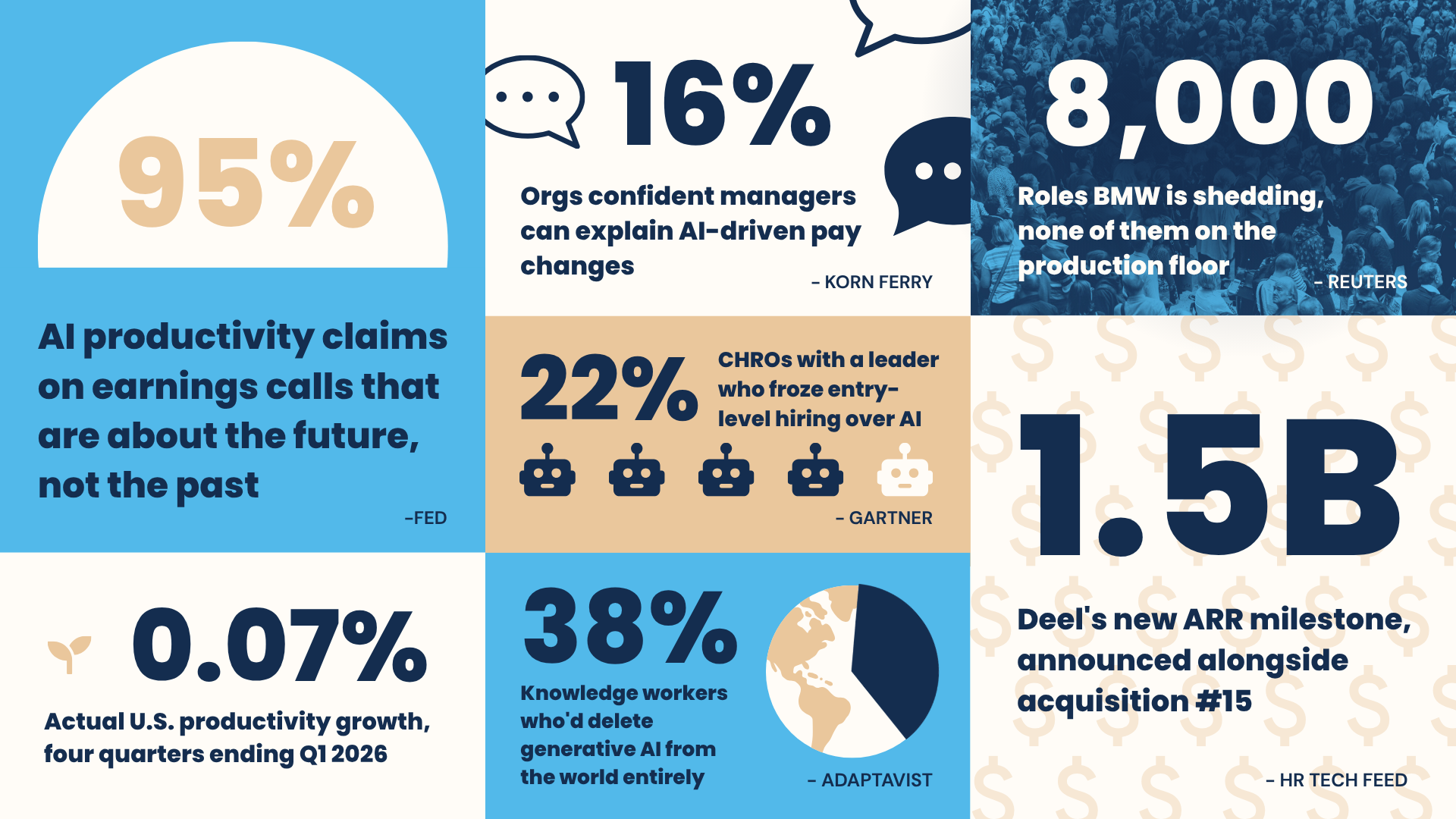
Here's a number that should reframe your entire fall planning cycle: 95%
That's the share of AI productivity statements on earnings calls that describe gains as still to come, not already banked. The Federal Reserve Bank of St. Louis ran an open-source
language model on roughly 490,000 earnings call transcripts from 5,198 public U.S. companies, dating back to 2000, tagging every productivity-plus-AI mention as past, present, or future.
Ninety-five percent future. For non-AI productivity talk, it's closer to 75%. Even the executives selling the story to investors are, on the record, describing a payoff that hasn't landed.
Meanwhile, your CFO is asking why headcount hasn't come down.
Three Things You Need To Know
1. The Fed just handed you a permission slip to slow down
Fed researchers Serdar Ozkan, Aakash Kalyani, and Nicholas Sullivan put it plainly: firms are
"investing, experimenting and reorganizing around AI today, while the measurable productivity effects remain mostly ahead."
AI mentions in productivity sentences were near zero pre-ChatGPT, climbed through 2023,
flattened in 2024, then jumped again in 2025 to roughly 15% by year-end. Talk is compounding nicely.
And the actual economy? The San Francisco Fed's utilization-adjusted total factor productivity grew 0.07% over the four quarters ending Q1 2026. Not 7%. Zero point zero seven.
What it means for you: If anyone in your org built a hiring freeze, a reduction plan, or a 2027 headcount model on the premise that AI has already delivered efficiency, that plan is running ahead of the data. You now have a Federal Reserve paper to put in front of leadership, which beats "I have a bad feeling about this." Ask directly: which process got faster, by how much, and how? If nobody can answer with a number from this year, the savings are a forecast, not a fact.
Dig deeper: HR Executive · St. Louis Fed original
2. An AI notetaker lawsuit is about to become an HR problem
A proposed class action filed July 30 in the Northern District of California accuses Granola, a venture-backed AI meeting notetaker, of recording conversations without telling most
participants and, by default, feeding them into model training. That's per the complaint in Chamberlain v. Granola — allegations, not findings. Nothing is proven, and every number in that filing is a claim.
Care anyway. Think about what runs through a notetaker inside an HR function. Investigation
interviews. Performance calibration. Comp discussions. Terminations. Accommodation
conversations touching protected medical information. The stuff that normally lives behind a locked door and a retention policy.
What it means for you: Most HR leaders have no idea how many notetakers are running inside their org, because nobody bought them centrally. A recruiter installed one. A People Ops manager connected one to her calendar during a busy week. They spread the way Dropbox spread in 2012, one person at a time, invisibly, until legal asks a question nobody can answer. Two-party consent states sharpen it further. And "we didn't know it was recording" has never been a great deposition line.
Dig deeper: HR Executive on the filing
3. Your managers can't explain AI-Driven Pay Changes
Korn Ferry's latest Global Rewards Pulse Survey found only 16% of organizations are confident managers can explain AI-related pay and work changes. Just 43% say managers understand reward strategy well enough to communicate it at all. Fewer than a third say managers can effectively explain pay decisions, full stop.
The report's language is unusually blunt for a consulting deliverable: "Managers are becoming the weakest link in the reward value chain."
What it means for you: You can build the most elegant skills-based job architecture in your industry, and it dies in a one-on-one where a manager shrugs and says "I think it's an AI thing." That’s a training problem you’ve deferred, not a communications one. If your total rewards strategy isn’t built with manager communication in mind from the start, it doesn’t matter how good the framework is on paper.
Dig deeper: HR Executive · Korn Ferry
On The Tech Side
Deel bought a deepfake detector and crossed $1.5B ARR. Acquisition #15, announced August 3: Clarity, doing deepfake detection, identity verification, and fraud prevention. Terms undisclosed. The pitch is a continuous "trust layer" from sourcing through device provisioning, and the number Deel cites (via Gartner) is that synthetic profiles and deepfake identity fraud could hit 25% of all job applications globally by 2028. Read that with skepticism — a vendor citing an analyst to justify purchase. But if you hire remotely across borders, you've probably already met a candidate whose interview presence didn't quite match their résumé.
Recruitics wants to standardize the application flood. On July 31, it announced a coalition behind the Open Job Context Protocol, aimed at AI-generated application chaos. Candidates mass-apply with AI, employers mass-screen with AI, both sides burn money to land where they started. Interesting swing. The question, as always with standards, is who signs on.
SAP is gating onboarding on compliance. SuccessFactors' Compliance Closure Gating blocks onboarding from closing until regulatory requirements are complete. Not glamorous. Extremely useful. The unsexy half of AI-era HR tech.
Paylocity posted its numbers. Q4 FY2026 recurring and other revenue of $415.6M, up 12.4% YoY, full-year total $1.771B. Steady growth while everyone argues about whether AI is eating the category.
What Else Is Going On?
BMW will cut about 8,000 roles. Voluntary redundancy confirmed to Reuters July 29, targeting administrative and development roles through 2027, production excluded. That makes BMW the third major German automaker this year after Volkswagen and Mercedes-Benz. Offers go out in October. Watch whether voluntary uptake alone gets them there — it tells you a lot about white-collar appetite for exit packages.
22% of CHROs have a leader who stopped hiring entry-level. Gartner surveyed 110 heads of HR: nearly a quarter have at least one leader who froze early-career hiring over AI. Also, 95% have implemented AI, and only one in five has seen significant value. Amazon is the counter-experiment, planning 11,000 interns and new grads this year while selling agents that automate recruiting and coding. AWS CEO Matt Garman on the mass-elimination thesis: "the math doesn't work out." Gartner's Kaelyn Lowmaster puts it practically — kill your early-career pipeline, and you'll pay a premium later buying talent you could have built.
38% would delete generative AI entirely. New Adaptavist research finds two-thirds of knowledge workers nostalgic for pre-genAI work, and 38% would remove the tools from the world if given the choice. Vendor-commissioned, so calibrate. But that's a big number to hand-wave past before your next rollout announcement.
The vendor-security story got weirder. Hugging Face CEO Clement Delangue told CNN that during the OpenAI-related breach, the first containment attempt came from an AI model whose own guardrails stopped it from acting. They ran an open model on their own infrastructure instead. Worth considering before you assume your vendor's safety features behave the way you expect on your worst day.
The Simple Advice
Build an AI notetaker inventory this week. Ninety minutes.
Not a policy. Not a governance framework. Not a committee. A list of which AI meeting assistants are running inside your HR function right now.
Ask IT for calendar integrations and browser extensions across the People team. Then, because IT's list will be incomplete, ask your team directly: what notetaker are you using, on which meetings, and did you turn it on yourself? Nobody's in trouble. You just need the list.
For each tool, answer three questions:
-
Does it record audio, or only produce text?
-
Does it train the vendor's model on your data by default, and can you turn that off?
-
Is it running on investigations, performance conversations, comp discussions, or anything touching medical or accommodation information?
That third one is the whole point. Chamberlain may go nowhere. But the discovery it generates, and the filings that follow, will make "which tools were recording your HR conversations" a routine question. Most HR leaders would need two weeks and a lot of awkward Slack messages to answer. Better to have the list before someone asks than after.
Bonus round: take the same three questions to your next vendor call and ask for written answers. The good ones will have them ready. The reaction from the ones who don't is, by itself, useful information.
The Fed data and the notetaker filing look unrelated. They're the same story from opposite ends. The gains are still mostly a forecast. The exposure is already here, sitting in a calendar integration nobody approved. That asymmetry- slow benefits, fast liabilities- is the shape of this moment, and it's why knowing what's running in your stack matters more this quarter than any strategy deck.
In the battle between the river and stone, the river always wins, not from sheer strength, but because of perseverance.
.png)



.png)